INTRODUCTION
An industrial combustion turbine can ingest over 1000lbs of air per hour of operation. Entrained within the air is a spectrum of mineral, salt, moisture, and VOC, and other compounds that are present in the local atmosphere. Locally high concentrations of potentially corrosive species may also be present due to surrounding industries or even effluent from the power plant itself, such as cooling tower drift, evaporation cooler deposits, or water treatment effluent.
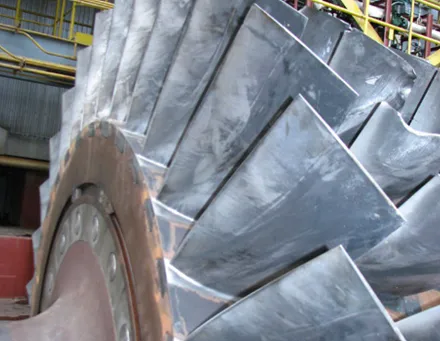
In addition to disrupting the flow path area of the compressor blades and vanes, with a consequential drop in compressor efficiency, these contaminants can also serve as sites for under-deposit corrosion cells that have implications for component life as well as risk for catastrophic failures. Compressor water washing with detergents has been utilized with some success by utilities as a method for mitigating the effects of deposit accumulation. Nevertheless, tenacious deposits can accumulate over time. The presence of moisture in the deposit can also result in activation of a corrosion cell that can corrode the typical stainless steels used for blade and vane construction. Higher strength PH stainless steel blades and vanes suffer a larger loss in fatigue endurance limit from pitting, and tend to suffer more airfoil liberations due to cracking initiated at pitting.
On forward compressor blades and vanes, qualified inspectors have also observed combined effects of leading edge erosion and pitting. The erosion is typically the result of on-line water washing. The roughness of the eroded leading edge is now an ideal area for compressor deposits to become deeply embedded. Additionally, it serves as multiple stress concentrations for fatigue crack initiation.
The fall in compressor efficiency, the irreversible damage due to erosion and corrosion pitting, and the risk of catastrophic damage due to fracture initiation at the affected areas, all suggest that O&M staff need to have a strategy to mitigate compressor deposit accumulation, as well as erosion channeling. Additionally, the strategy should also consider the scenario where some deposit accumulation is unavoidable and how to reduce the activation of these deposits. Consideration should also be given to units that have a history of blade failures due to a design limitations that makes them susceptible to corrosion fatigue cracking. In such cases, the unit has a low tolerance to the presence of corrosion pitting for crack initiation.