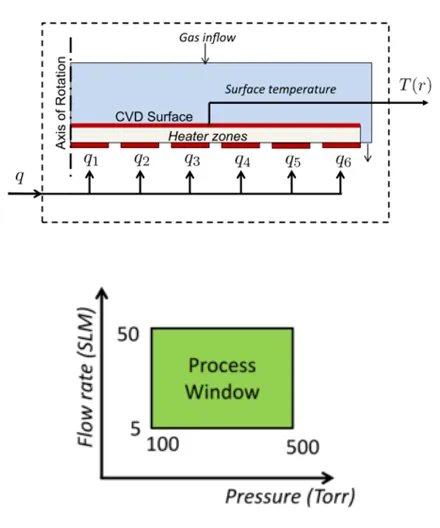
This case study describes the development of model-based temperature control of the susceptor of a Metal-Organic Chemical Vapor Deposition (MOCVD) reactor. A generic axisymmetric geometry has been used together with representative process conditions to highlight the issues related to the control of process temperature.
BACKGROUND
MOCVD is a deposition technique used to grow thin films on solid substrates (wafers) using organo-metallic compounds as sources. The films grown by MOCVD are usually semiconductors and are primarily used for the fabrication of electronic and optoelectronic devices that are components of mobile phones, optical communication, optical storage, light emitting diodes (LEDs), and solar cells. MOCVD is used to build up multiple layers of different materials, each of a precisely controlled thickness, to engineer a material with desired optical and electrical properties. One of the most important aspects in the MOCVD process for LED production is stringent temperature control. The color of the light emitted by an LED is a strong function of the substrate temperature during the deposition process. The wafer surface temperature uniformity directly translates into emission wavelength uniformity. To achieve a high yield, temperature control must be accurate, with very high wafer-to-wafer (WTW) and within wafer (WIW) temperature uniformity.
HOW MANY INDEPENDENT HEATERS ARE NEEDED?
In this case study, we discuss a method for estimating the minimum number of independent heaters that are needed to attain the desired steady-state temperature uniformity over the susceptor radius for a range of process conditions. Since each independent heater requires a separate power supply, minimizing their number is important from the viewpoint of lowering hardware costs.
THERMAL MODEL OF REACTOR
Our Model-Based Control approach begins with developing physics-based models of the system to be controlled. Here, the system consists of a vertical, axisymmetric reactor with top-side showerhead and rotating susceptor heated from below by six heaters with uniform flux that may be operated independently or in combination as “heater zones”, as shown in the schematic within the dashed box in Figure 1. The heaters may be resistive films, lamp arrays, hot filaments, or RF inductive elements.
From a control system viewpoint, the system input is composed of the set of heat fluxes, qi(r), corresponding to the ith heater zone, and the outputs are the temperatures T(r) measured at various radial points along the susceptor. The goal is to adjust the control flux, q(r), to obtain good temperature uniformity on the reaction surface.