One of Structural Integrity Associates’ (SI) strengths is combining state-of-the-art software with material science expertise to solve difficult structural and mechanical problems. A notable example in recent years is the Aircraft Impact Analysis (AIA) performed by SI for NuScale Power, using the ANACAP concrete material model. With SI’s support, NuScale’s Small Modular Reactor (SMR) building design passed NRC’s comprehensive inspection, bringing NuScale’s SMR technology one step closer to market [N&V Vol. 47 p. 5].
SI’s success in AIA is due not only to our team’s capabilities but also due to the capabilities of our proprietary concrete constitutive model, ANACAP, developed by Joe Rashid, Robert Dunham, and Randy James of ANATECH, now part of SI. Modeling reinforced concrete, which is both nonhomogeneous and anisotropic, is often a challenge in advanced structural analysis. However, ANACAP has a long track record of accurately capturing nonlinear concrete response in structural systems subjected to static, impact, and seismic loads. Its application goes beyond AIA; it has also been utilized in several of SI’s commercial building, bridge infrastructure, nuclear plant, and hydroelectric facility projects.
ANACAP has the ability to account for cyclic degradation, multi-axial cracking, load-rate effects, aging, creep, shrinkage, crushing, confinement, concrete-reinforcement interaction, and high-temperature softening behavior. The combination of these features results in an exceptional representation of concrete intricate behavior. It also leads to more accurate results when compared to standard finite element “built-in” concrete material libraries, all the while being implemented within the same standard finite element formulation.
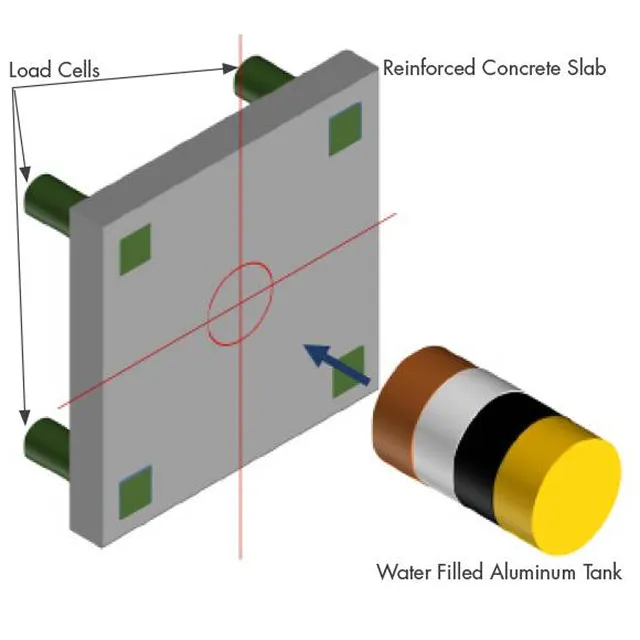
With the purpose of expanding ANACAP’s reach and better attend to our clients’ safety-related needs, SI is integrating the concrete model into the specialized structural analysis software LSDYNA, an explicit transient dynamic finite element code. Explicit finite element solvers are typically required to evaluate shock, blast, impact, drop, and other complex loading scenarios. Following the Nuclear Energy Institute (NEI) 07-13 guidance, this software coupling must be extensively tested and verified for a wide range of problems representative of missile impacts on reinforced concrete slabs. One of these problems is presented here--a water slug impact test (WS test), in which a waterfilled cylindrical aluminum tank impacts a reinforced concrete slab at a high velocity, as depicted in Figure 1.